
The Future of Work – and a brighter future for your community?
 Yesterday saw the publication of The Future Of Work, a key report created by Nationwide (the world’s largest building society, and a key UK employer) along with Ipsos MORI and many other contributors. Nationwide gathered 30 leading UK organisations to understand what the workplace could look like in a post-Covid world, and used these findings to help shape the report. It looks at how the pandemic has impacted different generations and demographics and how people might want to work in future.
The key conclusions about work are, unsurprisingly, that there will be more working from home than before the pandemic. More interestingly, the report is clear that while many people would like to work from home more, they don’t think their employers will be as keen. Many homes are not well-suited to working, and so a rise in suburban ‘hub’ workspaces might be envisaged. Some ‘office’ time will likely still be required, and younger workers will need this more to build their work networks and relationships. There are also Wellbeing challenges from too much Zoom time.
The report has an intriguing section, ‘Revenge of the suburbs?’, on the impact of all this on local urban communities. If people are commuting less, they have more time – up to six week per year more time – to do something closer to home. The report talks about the demand for local services like cafes, delis, gyms and hairdressers increasing (and indeed we have been seeing this in the lockdown already).
This is all great potential for Villages In The City. If there are folk spending more time in their local neighbourhood (rather than rushing off to town to work), then perhaps they are interested to join in and develop those communities? That’s where we come in.
Ex-commuters often have excellent Skills garnered at work, in communicating, working with others, creating graphics and publications, running websites and all kinds of things which they can use to create and help the neighbourhood. The thing is, getting involved in a community isn’t quite the same as leading a team or running a project at work. The Skills are closely related, but you need to deploy them in a slightly different way and with a different outlook.
For example, creating accurate and rapid ‘minutes’ or notes after a meeting is a good skill. What’s the purpose of these minutes – usually to hold people to account. That is how controlling organisations or institutions work. It’s in the minutes, and if you don’t do it we will shout at you/ridicule you/look disappointedly at you/mark you down. In helping to lead or participate in a community, there are other ways to encourage people both to commit to taking a (maybe small) action, and encourage them along with support, interest, encouragement and applause. What gets done is more to do with what is in people’s hearts than in the minutes.
If you would like to develop community in your own neighbourhood, Village In The City is here to help and support you, whether your interest has been sparked by spending more time at home in lockdown (as was mine) or whether you’re tuned in already to the benefits of having a network of connections in the streets around you. We are have a growing bank of resources, experts, webinars, support calls, our own online community and online courses (coming soon) – all for people like you.
 It’s easy to start to get involved.
- Sign up for information at http://villageinthecity.net
- Read our Manifesto and Charter (to see how well it resonates with you)
- Join our online community (free) and say hello – we’re looking forward to welcoming you.
Village In The City is led by Mark McKergow, a former itinerant author, coach and consultant who is building community in his own neighbourhood in Edinburgh, Scotland. The Village In The City project is currently supporting neighbourhoods as far apart as the USA, Austria, Belgium and Bulgaria as well as around the UK. You are invited to join us whether you’re an experienced community builder, just wanting to get started, or a professional with ideas to share.
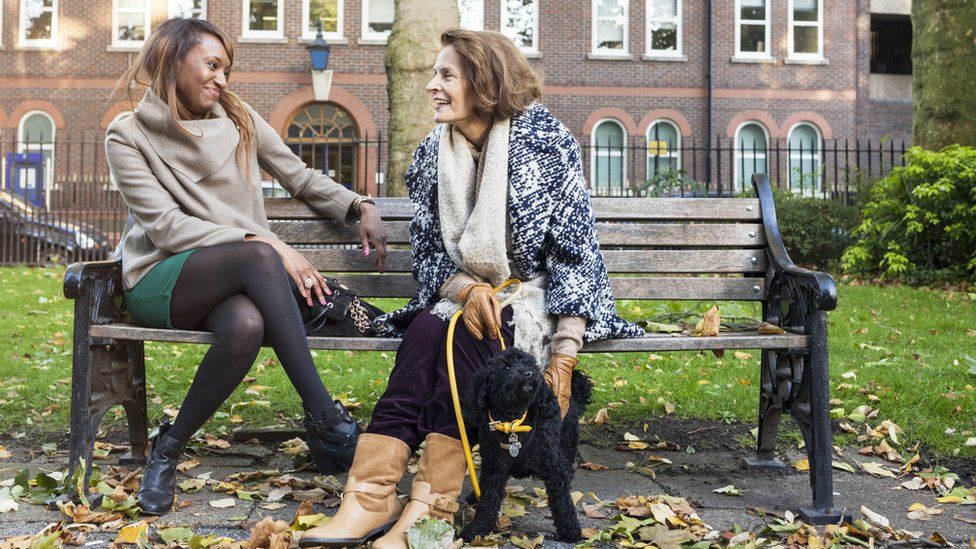


 What’s a good way to stay in touch with your neighbours? A Whatsapp group is one way to start. This App runs on smartphones, and shares text and photo messages with everyone in the group., (Many people also use it for communicating with other individuals too.) Lots of street Whatsapp groups have started in the pandemic, and it’s now possible to share some specific learning and ideas about what makes them work well, stay positive and play a useful role in the lives of your neighbours.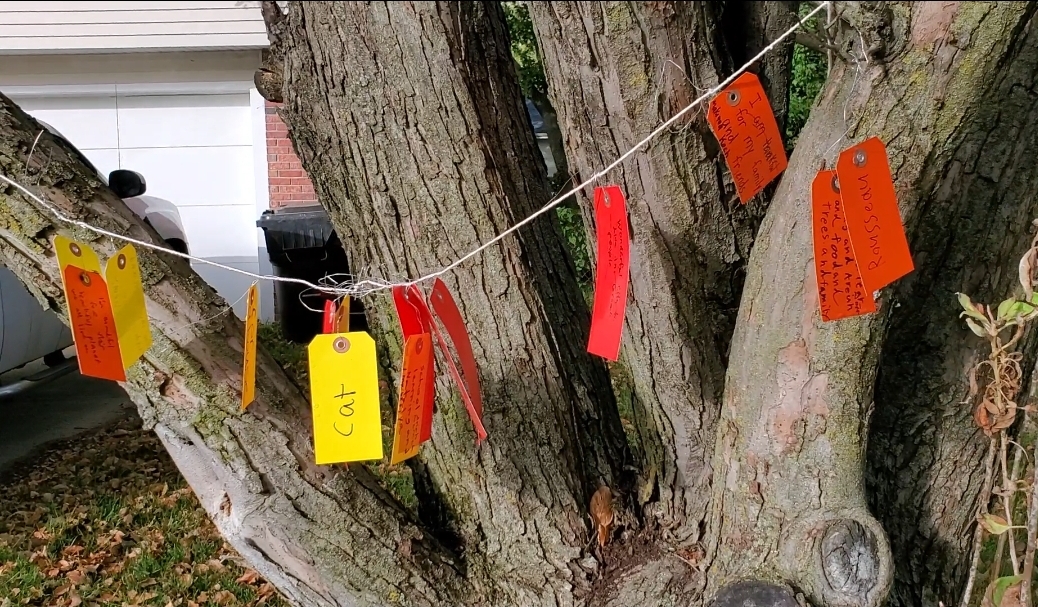
 At first, they fluttered in the wind by themselves, the two notes of gratitude. From a distance they almost looked like autumn leaves. Then, perhaps acting out of curiosity or even some sense of obligation, people began to jot their thoughts down on the tags provided and hang them on the tree. During the late summer of 2020, as we tired of the quarantine and began to venture from our homes, our neighborhood hosted a Gratitude Tree and it helped us all focus on what we were thankful for instead of being angry, afraid or annoyed by our fear of the COVID virus.
  Our Gratitude Tree was near the intersection of two sidewalks and had limbs low enough that we could tie some twine so people could easily attach their tags. We grabbed a graphic from the Web and produced a yard sign which we put in front of the tree. And, on a nearby fence, we provided a plastic mailbox with more tags and markers. The lid of the mailbox had a brief note that said: “
 As more and more tags fluttered in the breeze, you could almost feel a general attitude improvement in the neighborhood. The gratitude shown provide a general positive mood as people would drive or walk by. We plan to do it again and encourage you to give it a try in your village. It’ simple, it’s easy and it’s uplifting. Put a Gratitude Tree in your neighborhood, watch the notes begin to appear, then pull them down, make a list of the notes and share them with your neighbors. You’ll be glad you did.


 Our March 2021 call is now online and booking. Dilia Swart from Protection Approaches in London is joining us on Wednesday 17 March 2021 at 4pm UK time to discuss her work in using community development to address identity-based violence, whether that be motivated by ethnicity, gender, sexuality, religion or political affiliation. More details and registration are now available for this free call at
 We’re delighted to have a guest blog from Richard Lucas, our roving ambassador and Advisory Board member who has been a TEDx organisers for many years. Richard is very interested in creating informal spaces for interaction, and helped introduce us to Jenny Bimpson and the Chatty Cafe Scheme. Jenny was our guest in call #7, and you can
  In its key list of articles about what’s coming in 2021,

 We have had good success with a ‘photo of the month’ competition. We encourage members to post their photos of the area, and one of them gets selected (by the group admins) to be our header photo for the month. And of course all the pics can be seen in the group. This month’s pic is a dramatic shot of a local square by a 15-year-old photographer! (See it on the right.)
 Another aspect of connection is to use the public channels available. Paul has been touch with our local council, and as a result I now have keys to the official notice boards! These had been unopened for months due to the pandemic, and the department who looked after them have been dissolved in a reorganisation. I have tidied them up and create some new information pointing people to local shopping areas, beauty spots and hidden parks, adding QR codes so that visitors can immediately get more information on their phones. ‘Notice board monitor’ sounds like something you might be at primary school, but it’s certainly another way of getting information out to locals and visitors alike.