Neighbourhood democracy: Why we urgently need new models

New from me and Jenny on Substack:

https://markmckergow.substack.com/p/neighbourhood-democracy-why-we-urgently 

Jenny Clarke and I wrote this piece recently for the new In The Loop blog series by the European Consortium on Political Research. This strand is hosted by my good friend and colleague Titus Alexander, and is about how political science might help in saving democracy. (Read Titus’ introduction to the series here.)

Conventional democracy does not serve the community or neighbourhood level well. Mark McKergow and Jenny Clarke argue we must find alternative ways to facilitate inclusive action, support those seeking to make a difference (often with tiny resources), and build co-operation. Here, they set out key features of neighbourhood democracy, and suggest relevant practices as inspiration

In the UK (at least), the word ‘democracy’ implies the party-based oppositional systems we see at Westminster, the devolved nations, and in every town hall in the land. One group is in power and charged to get things done, another group opposes. Such systems are based on classical ideas of robust truth standing firm in the face of criticism; however much mud is slung, truth will prevail.

The shortcomings have rarely been clearer than in the past decade of polarisation. A deeply divided political landscape actively discourages co-operation between groups. The opposition want to take power, so they must make the others look bad. The governing side looks weak if they take up ideas from the opposition, who in turn look weak if they support a half-good idea.

Read more at https://markmckergow.substack.com/p/neighbourhood-democracy-why-we-urgently


The hazards of excluding communities from active health creation – and what to do about it

Ignoring the lens of community development in health Care is not only a missed opportunity; it brings hazards and long-run dangers too. 

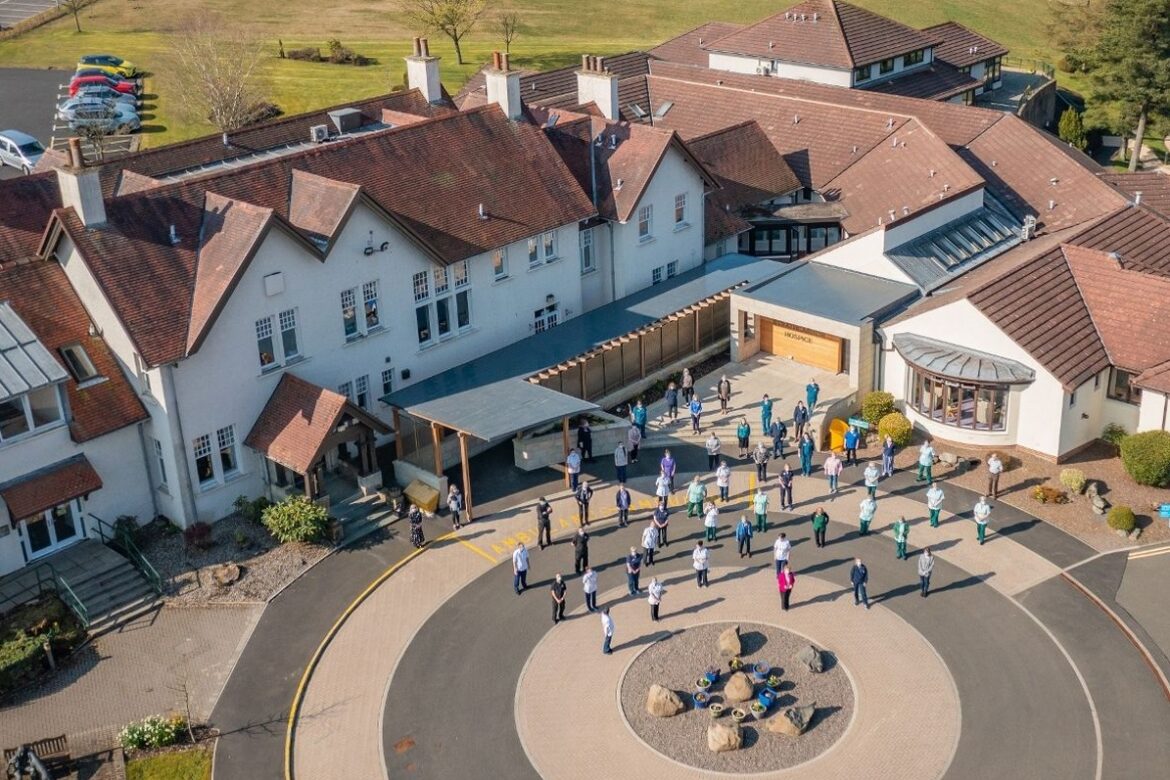
That’s the message of Cormac Russell’s recent paper Understanding ground-up community development from a practice perspective published in the open access journal Lifestyle Medicine.  The paper describes the change of focus of Strathcarron Hospice near Falkirk, Scotland from community engagement to community development.

This shift between 2018 and 2021 has resulted in a different kind of relationship between the hospice and the community – increasing community-first initiatives, people asking questions before they needed support, increasing community capacity to support neighbours, higher levels of trust, and more awareness of the dangers of professional over-reach. In seeking to help in disempowering ways, the hospice realised that they may be doing harm. In this post I will first summarise Cormac’s points, and then look at some of the ways forward (and pitfalls we might foresee).

In the article, Cormac Russell presents three lenses through which the relationship between communities and institutions can be viewed:

The Relief lens: the well-being of individuals is seen to be the result of services provided by professionals. ‘Clients’ of these professionals have needs that only the professionals can address – they are ‘needy’, not ‘needed’ as at least part of the solution. (Professionals do of course have a part to play, and may need to take a lead in crisis situations – but this is not a desirable place to be long-term.)

The Reform lens:  Usually layered over the relief lens, the reform lens stresses the need for systems and institutions to be reformed to help alleviate the needs of the community.  While this is a step forward, it is still an institution-focused view. Non-profit agencies may seek funding to achieve this – funds which then don’t go to the community. The reform lens can indeed bring improvement for citizens, but mediated through those who speak the language of government and prioritise professional interventions.

While these lenses are both necessary in some ways, they bring hazards. This is where Cormac Russell’s article is startlingly clear. He clearly and concisely lists these hazards in a way I haven’t seen before. They are (quoting from the paper):

  1. Individuals and groups are labelled and defined by their perceived weaknesses and conditions, not by their strengths and capacities.
  2. Most of the money intended for communities ultimately goes to those providing services to them.
  3. Active citizenship and grassroots activity retreat into the background, overshadowed by institutional largesse and overreach.
  4. Regular people and associations see themselves as inadequate and underqualified compared to professional helpers. Consequently, they become disabled.
  5. Residents accept that professionals and programmes imposed from the outside are their best hope for responding to end-of-life support needs.
  6. Individuals and communities are understood and come to see themselves as consumers, not producers. Thus, they outsource death, dying, and other health- and well-being-related issues to a licensed professional or institution.
  7. Institutional progressives will speak of prevention of illness while rarely talking about community health creation, because the latter relocates authority and resources towards community alternatives and away from traditional institutional interventions. (Russell, C., (2022), Lifestyle Medicine e269, https://onlinelibrary.wiley.com/doi/10.1002/lim2.69)

While Russell related these hazards to the activities of the hospice and end-of-life Care, they surely have a broader truth. Community health creation (and the creation of well-being, safety, longevity, child-raising, Care and much else) is kept out of the picture, not least by professionals who seem to value retaining their expertise, power and funding over supporting citizens and communities.

Cormac Russell then presents his third lens:

The Community lens:  The neighbourhood or community is the basic unit where health and other things are produced. Citizens “are recognised as having capacities to produce health, safety, and prosperity. This lens reveals neighbourhood associations as contexts in which to create and locate many sustainable supports, especially for those at the economic and social margins who are in need of Care and support” (Russell, 2022).

This is, of course, a paradigm shift in thinking about our society.

Cormac’s article continues with ways to set about building this new paradigm using Asset Based Community Development ideas. These are laudable and well worth exploring in terms of on-the-ground community building. One way to engage with these ideas is though Village In The City, which supports and encourages people to build micro-local communities in their own streets, blocks and neighbourhoods.

I’d like to set out here some of the ramifications of this paradigm shift to community-led work. If we are to make practical progress it will not (I think) be down to a lack of good ideas. Cormac Russell’s new book with John McKnight, The Connected Community, (published today) is a fine source of practice and wisdom. I think a bigger challenge will be practical stumbling blocks. As people start to encounter and engage with this new way of acting in community, it will feel a bit strange and there will be come unintended consequences.  Here are some ways we can help ourselves as this shift builds and develops:

  • Practical examples: The experience of Strathcarron Hospice is an excellent starting point. We will hope to hear more as they continue their journey. We will benefit greatly from more practical on-the-ground examples of communities coming to a point where they are taking a lead, setting goals, making plans and implementing them (with the help of, not in the teeth of, professionals).
  • Doing it in a community way: Cormac Russell talks about evolving a local Stewardship group, to act in deepening the connections within the local association of associations. It would very easy for such a group to slip into being (or appearing to be) an institution.  What forms of governance can support the combination of openness and responsibility that will come with financial, political and ethical considerations?
  • Value small steps: This transformation will not come as an immediately useable complete package. There will be small steps – a small project with the community driving here, a small bit of strings-free money there. It will be all to easy to dismiss these small steps as ‘not enough’, ‘a gesture’ or ‘sticking plaster’. We must take Care to present them as early signs, forerunners of a new way of living.
  • Prepare for local variety: There will be lots of ways to do this. Different places are bound to evolve different ways to achieve a residents-in-control level of participation. We must prepare to celebrate the differences rather than to seek to meld everything into a uniform approach. And yes, someone will complain about the ‘postcode lottery’ where people in one street have much more involvement than people in the next street. It’s part of the process, not a design flaw – cheer, support and use the difference as a driver for change, not something to moan about.
  • Engage the professionals: They are not, despite the impression I might have given above, the enemy. They will take time to adjust to a revised relationship too. Make it clear that partnership with the community will make their professional lives better, as well as their day-to-day experience of living as citizens. They will need to be valued even more by the community – but in a different way, as supporters and highly-skilled team members rather than authority figures to be obeyed at all times.
  • Treat slip-ups as valuable learning: There will be slip-ups and mishaps along this journey – times when things go wrong, slip through cracks, become left aside. There will be those who will shout that ‘this wouldn’t have happened if the professionals were still in charge’. Maybe not, but who would learn to walk or ride a bike if never given the opportunity?  This points again to working with the professionals as allies, not seeing them as the competition.

These five pointers will help to make the shift to community-led living a firmer and more sustainable reality.  The way ahead is hard enough without being prepared at some level for problems which will inevitably occur somewhere at some time (and probably in many places many times).

Mark McKergow, Village In The City

Host a Jane’s Walk – a simple, imaginative and encouraging way to connect with your micro-local community

Here at Village In The City we love things that are simple and effective. And we’ve just come across the international Jane’s Walk movement, which offers an excellent way to connect with your neighbours in an imaginative yet low-risk and creative way.

Jane’s Walk is a community-based approach to city building that uses volunteer-led walking tours to make space for people to connect around their neighbourhoods. It was founded in Toronto in 2006 in honour of community urban activist Jane Jacobs (1916-2006). Over the next decade, the movement saw rapid global uptake. In 2017, 1,700 Jane’s Walks took place in 225 cities around the world, spanning 37 countries and 6 continents. The movement continues to grow every year, with a focus on events around Jane Jacobs’ birthday in early May (this year 6-8 May 2022).

Jane’s Walks encourage people to share stories about their neighbourhoods, discover unseen aspects of their communities, and use walking as a way to connect with their neighbours. They are:

  • Free, volunteer-led, and open to everyone
  • Non-commercial and non-partisan
  • Seek to promote dialogue – they are not ‘walking lectures’.

Hosts do not need to be experts, professional tour guides or anything else. They should have a desire to connect with people in their neighbourhood, plan a route, welcome them on the day and share stories as they walk for an hour or so.

Village In The City founder Mark McKergow is bringing Jane’s Walk to Edinburgh, Scotland this year, and it’s exciting that this is the very first time it’s happened anywhere in Scotland! You can see more about the Edinburgh events on their website.

So, could you host a Jane’s Walk in your neighbourhood? It’s relatively easy to do, there is no commitment beyond doing it once, and it could lead to some interesting and useful connections as well as re-visioning aspects of your local landscape and community. Here’s what to do:

  1. Check if there is already a Jane’s Walk city host for your city – http://janeswalk.org/cities/. If there is, contact them.
  2. If there isn’t an existing host, you can apply to be one. http://janeswalk.org/add-a-city/
  3. And/or you can just declare that you’re doing a Jane’s Walk in your area and go ahead! https://janeswalk.org/get-involved/lead-a-walk/

It’s worth getting involved with your city host – they will have access to graphics and resource to help you.  With just a couple of weeks to go until Jane’s Walk Festival 2022, there is still time. Go for it! (And let us know here how you get on.)

Jane Jacobs


“45° Change”: What could happen when communities meet institiutions?

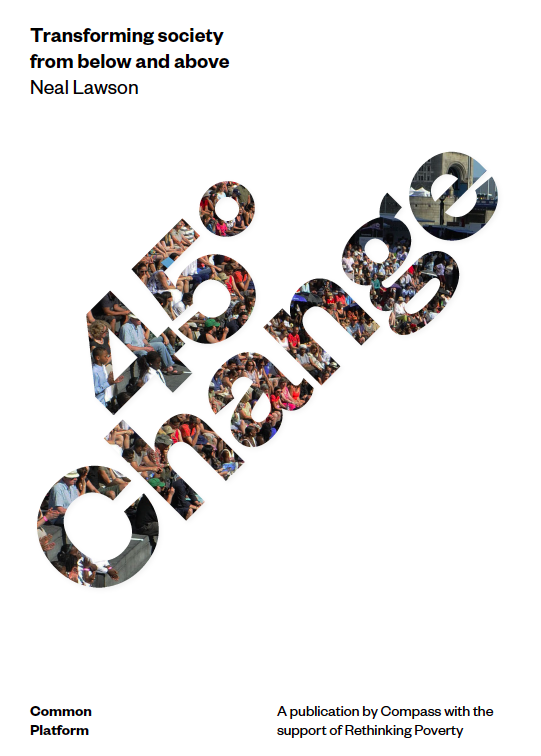
I had a very interesting talk yesterday with Colin Miller, an experienced and now retired community developer who leads the Deeper Democracy group. Colin wrote Rethinking Community Practice nearly a decade ago, and is still very interested and engaged in how change can happen in communities and in wider society.  Colin introduced me to the idea of ’45° Change’, first set out in 2017 in a pamphlet by Neal Lawson.

The idea is that change across society cannot be thought of in simple top-down OR bottom-up ways.  It’s not even both top-down AND bottom-up, because institutions and communities work in fundamentally different ways.  The difference is reflected in the ‘institutional triangles and community circles’ way of thinking which we’ve included in our Village Builder course over the past few weeks.  Institutions work with hierarchy to produce goods and services for users and consumers, while communities act in a much flatter horizontal mode of connection and mutual action.  So what happens when vertical institutions meet horizontal communities?  One possibility is that we get 45° Change.

Village In The City is about helping people to develop micro-local communities.  So we’re primarily interested in helping you to grow community organisation in your neighbourhood.  The question will arise, at some point, about how these community groups interact with local government and other institutions which have a role in what goes on locally.  What the 45° Change people led by Neal Lawson, Caroline Hartnell and others have recognised is that this is unlikely to be played out on either the top-down institutional model or the sideways community model, but will very likely have to see new ways to interrelating and working developing as both parties seek to find ways to go forwards in everyone’s interest.

Institutions are not very likely to be interested in giving away their power in the first instance, and so much of the way will have to be forged by enlightened voices on both sides.  Communities and other horizontally-oriented groupings have a leading role to play in developing new ways to work.

You can read a good short summary on the Rethinking Poverty webpage, and download the full pamphlet from Compass, a cross-party group for those who want to build a Good Society.

So – what ways have YOU found to connect with local government and institutions in your neighbourhood?  What’s working? What issues are you finding?

The Future of Work – and a brighter future for your community?

Yesterday saw the publication of The Future Of Work, a key report created by Nationwide (the world’s largest building society, and a key UK employer) along with Ipsos MORI and many other contributors. Nationwide gathered 30 leading UK organisations to understand what the workplace could look like in a post-Covid world, and used these findings to help shape the report. It looks at how the pandemic has impacted different generations and demographics and how people might want to work in future.

The key conclusions about work are, unsurprisingly, that there will be more working from home than before the pandemic. More interestingly, the report is clear that while many people would like to work from home more, they don’t think their employers will be as keen. Many homes are not well-suited to working, and so a rise in suburban ‘hub’ workspaces might be envisaged. Some ‘office’ time will likely still be required, and younger workers will need this more to build their work networks and relationships. There are also Wellbeing challenges from too much Zoom time.

The report has an intriguing section, ‘Revenge of the suburbs?’, on the impact of all this on local urban communities. If people are commuting less, they have more time – up to six week per year more time – to do something closer to home. The report talks about the demand for local services like cafes, delis, gyms and hairdressers increasing (and indeed we have been seeing this in the lockdown already).

This is all great potential for Villages In The City.  If there are folk spending more time in their local neighbourhood (rather than rushing off to town to work), then perhaps they are interested to join in and develop those communities? That’s where we come in.

Ex-commuters often have excellent Skills garnered at work, in communicating, working with others, creating graphics and publications, running websites and all kinds of things which they can use to create and help the neighbourhood.  The thing is, getting involved in a community isn’t quite the same as leading a team or running a project at work.  The Skills are closely related, but you need to deploy them in a slightly different way and with a different outlook.

For example, creating accurate and rapid ‘minutes’ or notes after a meeting is a good skill.  What’s the purpose of these minutes – usually to hold people to account. That is how controlling organisations or institutions work. It’s in the minutes, and if you don’t do it we will shout at you/ridicule you/look disappointedly at you/mark you down. In helping to lead or participate in a community, there are other ways to encourage people both to commit to taking a (maybe small) action, and encourage them along with support, interest, encouragement and applause. What gets done is more to do with what is in people’s hearts than in the minutes.

If you would like to develop community in your own neighbourhood, Village In The City is here to help and support you, whether your interest has been sparked by spending more time at home in lockdown (as was mine) or whether you’re tuned in already to the benefits of having a network of connections in the streets around you.  We are have a growing bank of resources, experts, webinars, support calls, our own online community and online courses (coming soon) – all for people like you.

It’s easy to start to get involved.

  1. Sign up for information at http://villageinthecity.net
  2. Read our Manifesto and Charter (to see how well it resonates with you)
  3. Join our online community (free) and say hello – we’re looking forward to welcoming you.

Village In The City is led by Mark McKergow, a former itinerant author, coach and consultant who is building community in his own neighbourhood in Edinburgh, Scotland.  The Village In The City project is currently supporting neighbourhoods as far apart as the USA, Austria, Belgium and Bulgaria as well as around the UK. You are invited to join us whether you’re an experienced community builder, just wanting to get started, or a professional with ideas to share. 

Co-housing: building community in shared space

Richard Lucas of TEDx Kazimierz in Krakow, Poland has joined our Advisory Board (thank you Richard!). He has shared this excellent TED video from 2017, featuring Grace Kim talking about co-housing, an innovative way of building community within shared space.  Richard writes:

“Greetings from Krakow, Poland – This is my first post. I was sharing information about this great project with my TED Circle this evening. with guests from Canada , Germany, Israel, India, Poland, Romania and the USA.  We were discussing Kim Grace’s thought provoking TED talk on co-housing which is a different approach to designing and living with community as a high priority. The links with the manifesto Mark drafted are obvious.”

About the talk: Loneliness doesn’t always stem from being alone. For architect Grace Kim, loneliness is a function of how socially connected we feel to the people around us — and it’s often the result of the homes we live in. She shares an age-old antidote to isolation: cohousing, a way of living where people choose to share space with their neighbors, get to know them, and look after them. Rethink your home and how you live in it with this eye-opening talk.

The 15-minute city: a new picture for urban living

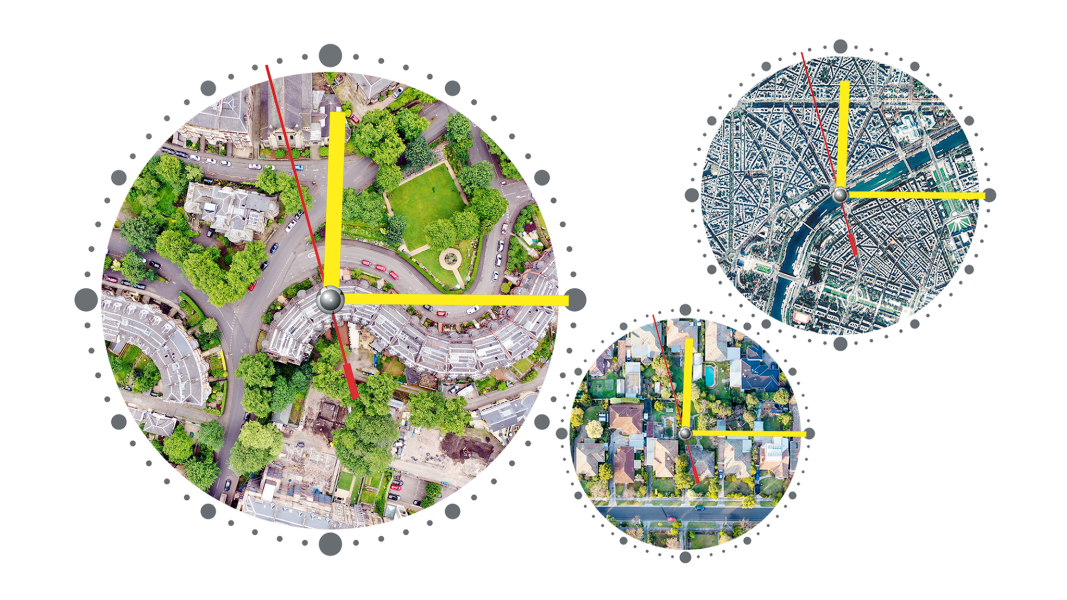
The idea of a ’15-minute city’ is arriving onto the scene from several sources at the moment.  The Weekend FT published this piece by Natalie Whittle examining the idea of having everything you need within a 15 minute radius (walking or by bike) of where you live.  She reports what many people are experiencing: working from home gives a new attention to one’s immediate neighbourhood. This trend has been rapidly accelerated by the COVID pandemic, with French car giant PSA (Peugeot, Citroen, Vauxhall) moving non-production staff to permanent home working. Carlos Moreno of the Sorbonne in Paris created the idea of the 15-minute city, and is advising Paris mayor Anne Hidalgo. Paris is one city which is already experimenting with much-improved cycle routes too, which helps atmosphere and health as well as keeping a local focus. The 15-minute neighbourhood idea has also been picked up by Camden council in London, with this article in Medium. There is also another longer article on Bloomberg by Patrick Sisson.

One point made in the article is particularly relevant to Village In The City advocates and supporters.  Moreno says “we don’t want to recreate a village; we want a create a better urban organisation”. Us too.  One persistent criticism of micro-localism is that it would constrain people to a small area around their houses. Of course, this is not the case.  As cities develop, there will still be things we can’t get within our immediate neighbourhoods. I play saxophone in a big band, and I am unlikely to find a top-class group within 15 minutes walk.  However, what a great basis for a life, to know people around you, be familiar with local suppliers and meeting places, to smile and greet people in the street. Having a life in your village is not an opposite of being active on a wider scale – it’s more of a necessary counterpoint.  It balances our attention, provides a wider network of connections (including cross-generational and cross-demographic) and offers the chance of a rich life on the doorstep as well as on the train or plane.

Want to start building your village? We’re here to help.  Go to our Building Your Village page to find out more.

Village In The City is a post-COVID initiative to help you build micro-local communications and communities where YOU live.

Sign up

Our Contacts

20 Atholl Crescent, Edinburgh EH3 8HQ

+44 (0)7976 936086

mark@villageinthecity.net