The mega-importance of micro-interactions – in community building and elsewhere

I’ve just published two posts on Steps To A Humanity Of Organisation about the mega-importance of micro-interactions. Part 1 deals with micro-aggressions and how seemingly small remarks can become intolerable for those at whom they are aimed. Part 2, on a more positive note, looks at micro-solidarity and micro-affirmations and how (different) small remarks can help build and sustain relationships.

Part 1: https://markmckergow.substack.com/p/30-the-mega-importance-of-micro-interactions

Part 2: https://markmckergow.substack.com/p/31-the-mega-importance-of-micro-interactions

Steps To A Humanity Of Organisation is free to read and subscribe to. Do it today!

Connection – our topic for September

We’ll be looking at one of the six key elements of a Village In The City each month. This first month, the topic is Connection within the village.

This is a vital starting point in building your Village In The City. How do people connect and communicate with each other? Back in the mists of time this was a combination of folk meeting in the street/market place/tavern/ church and some kind of ‘official’ news via the town crier, parish magazine, community noticeboard or whatever. These days, of course, the channels available to us are many and varied. Noticeboards can still be useful!

So let’s start by looking briefly at some good possibilities for building connection within your Village In The City.

One-way and two-way connection

Some of the older methods of communication are one-way. A paper newsletter connects the editor to the readers – but not really the other way around (unless there are letters etc – but that takes a long time). A noticeboard is a very useful thing, but who decides what is displayed? These connection methods give a lot of power to the ‘guardians’ of these outlets. Of course, those people may well have the best interests of the community at heart – but these channels don’t of themselves get people talking to each other.

One key thing is that this connection has to be, in some ways anyhow, two-way. It’s no longer enough to have one person in charge of sending out ‘communication’ to everyone else. We need ways in which citizens can connect with each other directly. Fortunately the tech revolution has made this much easier (in some ways). Facebook groups, Whatsapp groups, online forums, social media all have a part to play.

So let’s start the conversation here.

  • What connection methods do you use in your community?
  • How well do they work? What are the strengths and weaknesses?

Do please join in. The discussion is happening in our online community site powered by Mighty Networks. Do join if you haven’t already – it’s free and you also get updates and easy access to our events.

(Lots more about how to build Connection in the latest Village Builder Handbook – free download here.)

Exciting news about the Autumn 2022 Village In The City programme

I hope you’re all enjoying your summers. I’ve been thinking about how to continue the development of Village In The City. Here is what’s in the pipeline for this Autumn and the next few months.

New podcast recordings

We’ve been building up a podcast collection from past call recordings (available wherever you get your podcasts, Apple, Google, Amazon etc, or just click here to listen and subscribe). I will be recording some new podcasts with new guests who have something interesting to say about creating, sustaining and empowering micro-local communities. The recordings will be open to members to join us live, ask questions and get involved. Look out for news in the events section!

Topic of the month

As you may remember, our Manifesto outlines six key elements for a successful and thriving neighbourhood community:

  • Connection
  • Hosts
  • Meeting places
  • Inclusivity
  • Inclusive events
  • Identity

We will be focusing on one of these elements every month. The first will be in September 2022, when there will be a focus on Connection. Look out for blogs, polls, discussions, calls and resources during that month!

Continuing learning and sharing calls

Our monthly calls will continue in a similar way, where any member can bring along news, successes, questions, challenges, problems or anything else about your micro-local community and we can all work on it together.  A new feature will be some space for the ‘topic of the month’ as well as general discussion and issues.  Dates for these calls are:

  • Wednesday 17 August 2022
  • Tuesday 13 September 2022
  • Wednesday 19 October 2022
  • Tuesday 22 November 2022
  • Wednesday 14 December 2022

These one hour Zoom calls are always at 7pm UK time. That normally translates as 8pm CET, 2pm EST, 11am Pacific.  These calls will appear in the Events section of our community website and are free to join. You’ll get a warm welcome, the chance to meet other neighbourhood community builders from around the world and you’ll share and learn with us all.

Use the site!

Our Mighty Networks community website offers you the chance for you to post news of your community, share updates, ask for ideas and support and share new ideas and resources from the international world of Asset Based Community Development.  Please use it, and respond positively to those who do. Join us free at https://members.villageinthecity.net.

I’m always very open to suggestions and ideas about other things we can do together and can offer to members and community builders around the world. Please let us know your ideas, hopes and preferences in the comments below.

Hope to see you soon at one of our upcoming events.

Cheers, Mark

New podcast: Building safe, strong and inclusive communities with Dilia Swart, Protection Approaches

Our ninth podcast is out today! Dilia Swart and her colleagues from London-based charity Protection Approaches talk about  their experiences of inclusive community building as a way of fighting identity-based violence. (And even if that isn’t an issue for you specifically, they have a lot to say about how to build safe, strong, inclusive communities).  You can subscribe to our podcasts wherever you usually get yours (Apple, Google etc) or just listen here. https://shows.acast.com/village-in-the-city/episodes/episode-9-safe-strong-cohesive-communities-with-dilia-swart

Dilia Swart talks about her work in building strong safe communities to protect people from identity-based violence in London and elsewhere.

The latest Village In The City podcast welcomes Dilia Swart of Protection Approaches to talk about their work in building communities as a means of working to prevent identity-based violence. Protection Approaches was established as a UK charity in 2014 working to end all forms of identity-based violence motivated by the perpetrator’s conceptualisation of their victim’s identity, for example their race, gender, sexuality, religion or political affiliation. It encompasses hate crime, violent extremism, and genocide and affects individuals as well as entire groups or communities all around the world.

A key part of this work is helping to build active, safe and strong communities where marginalised communities and voices are included. They work to broker new and sustainable community relationships that will facilitate community-led change in some of London’s most disadvantaged boroughs, and also run (very good) community development programmes supported by the Mayor of London and the Home Office. These programme aim to encouraging community-led responses to hate crime and the prejudice and marginalisation that can lead to such crimes.

Dilia Swart is Senior Education Officer at Protection Approaches, and leads the delivery of their education programme working with schools to promote positive school cultures that foster tolerance and build resilience to divisive narratives. She was the co-founder of the Mostar Summer Youth Programme, an educational project in Bosnia-Herzegovina, and has degrees from Harvard and SOAS. Dilia and her colleagues share how the particularly tough issues of identity based violence can be tackled from a community perspective and share her experiences of working in London and elsewhere.

Listen at https://shows.acast.com/village-in-the-city/episodes/episode-9-safe-strong-cohesive-communities-with-dilia-swart or subscribe to the Village In The City podcast wherever your normally gets yours from (Apple, Google etc).

NEW podcast: The Chatty Café Scheme

Loneliness is a problem facing many people around the world. Particularly in cities and urban contexts, it’s so easy to be surrounded by people and yet feel unconnected and peripheral.

This month on the Village In The City podcast our guest is Jenny Bimpson, one of the key organisers behind the Chatty Cafe Scheme. It’s so simple – cafe and pub owners are invited to designate a ‘Chatter & Natter’ table where folk are invited to sit if they want to talk. From small beginnings in the UK the scheme has gone international! It is also running online chatty tables during the pandemic.

We talk to Jenny about how it all started, their experience of getting people engaged, both as hosts and as natterers, and how it can help in the development of micro-local community and connection. Our members also contribute their own experiences of different ways to encourage people to talk to each other from around the world.

Get the Village In The City podcast wherever you normally find podcasts (Apple, Google etc), or see the full series online at https://shows.acast.com/village-in-the-city.

Is the tide with you or against you? Picking your time in Asset Based Community Development

Ask any sailor and they’ll tell you that the state of the tide is very important.  Pick the right moment to set out, and the tide will help you along the way. Pick the wrong moment, and everything gets much harder.  This is not a matter of setting out or not, it’s just that it’s much easier at certain times than others.

I think that the same applies to our work as micro-local community builders with Village In The City.  It’s not just a matter of having good ideas and the Skills to connect with people and make things happen. There are clearly times which are more (or less) opportune to get something going.

We discussed this at the February 2022 Village Builders call on Village In The City.  People from Austria, Bulgaria, Portugal and the UK came together online for our monthly learn, share and support session.  This topic was on the agenda (which we put together at the start of the call so everyone has the opportunity to bring a topic), and it led to a lively discussion.  Everyone thought that timing was a factor, and we shared things which might be signs that the tide is favourable or not for community building work.

Times in the year

The seasons of the year bring natural opportunities.  Here in Scotland, it’s no use trying to get people’s attention around Christmas with something new – they are all thoroughly taken up with family and other events.  (Of course, you can use Christmas time as a good reason to have a community event/get-together – but you have to organise it well in advance!) Where I am in  Edinburgh, August brings the Edinburgh Festival, the world’s biggest arts festival.  Our neighbours are either spoilt for choice about things to do, or have left town for the month to avoid the rush. Not a great time to be proposing new initiatives.

Academic timetables

One participant was a TEDx organiser who said that the academic year had a similar pull/push factor.  A lot of his volunteers were students, and so doing things within term time (and avoiding exam periods) was important.

National days and festivals

This is another factor which can work in both directions. National days and other holidays can be a good reason to get together – or they can take up peoples’ attention with other things.  Again, probably best to get things moving well before hand.

Crises and emergencies

We have all just seen how the COVID pandemic has brought about changes in the ways we interact in our neighbourhoods.  There can be other emergencies too – a flood, loss of electric power, catastrophic storm damage – any of which can be a good spark for community action.  Rallying round our neighbours in a crisis is an excellent way to make progress, and it needs to happen quickly. Or maybe if there’s an emergency somewhere else, you can rally your community to go and support (like this Sikh community from the Midlands went to the South West of England to help following huge floods in 2014).

Generational factors

Different age groups can be engaged and energised at different times.  School students may be more open to things when they are on holiday.  New parents can be in need of support and connection when their babies are on the way.  Older people may want to come together to remember events from the past.  And of course there can be cross-overs between these things (like the partnerships between Care homes and nursery schools) which seem to benefit everyone.

One of our members related this idea of timing to farming. “There are times to plant, and times to let the land lie fallow.” Another related it to the 16th century Protestant reformer Martin Luther, who said “where your attention is, there is your strength”.

What do you see as good (or bad) signs that the time is right to get new things going in your community?  Please comment below!

Village In The City offers a free online community on the Mighty Networks platform, open to all who or engaged or interested to create better micro-local community in your own area. It’s free, we hold events and calls, there are short courses, and it’s a great way to be part of a bigger group of skilled and enthusiastic Village-Builders all over the world. Please join us now.

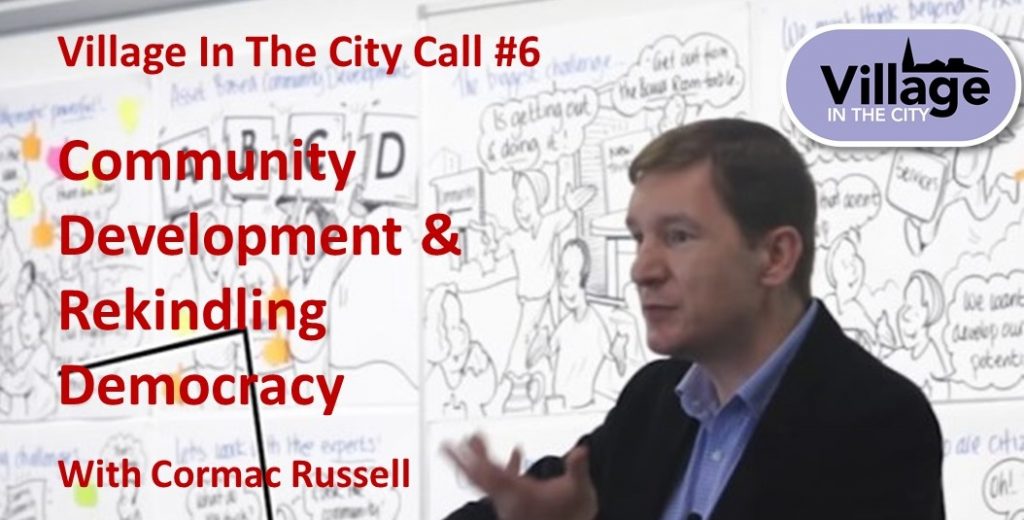
NEW podcast with Cormac Russell – community development and rekindling democracy

Out today – a new podcast from Village In The City featuring Cormac Russell! 

Cormac Russell is a passionate advocate for bottom-up community development, carried out BY citizens for their own communities. He is a long-term expert in Asset Based Community Development (ABCD), and says that finding and building ‘what’s strong’ is vital in dealing with ‘what’s wrong’. Who gets to decide what the priorities are? What is the role of outside professionals and experts? And how can this make communities which are not only stronger but also more democratic and empowered?

We are thrilled that Cormac agreed to join us at Village In The City for a lively call. He is a genuine international star, and his new book Rekindling Democracy has been making waves around the world. This promises to be an exceptional call, with Cormac’s passion for asset-based action meeting Village In The City’s Mark McKergow’s three decades in Solution-Focused change and host leadership.

Cormac speaks about the importance of bottom-up community building, relationships with institutions and professionals, and answers questions from participants. The call was recorded in December 2020.

NEW podcast episode: Engaging with churches

This podcast presents material from my talk with Rev Nick Bowry, Rector of St James The Less in Penicuik near Edinburgh in Scotland.

Churches have long held a role in building community – but what kind of role can they play in an inclusive and broadly secular world?

Village In The City is all about building micro-local communities to enhance the lives of everyone in the neighbourhood, which may include one or more churches. Village In The City values inclusivity – so how are we to think about, and work with, churches which may appear to be there mostly for their congregations and followers? Village In The City founder Mark McKergow is joined by Rev Nick Bowry, rector of St James the Less Episcopal Church in Penicuik and St Mungo West Linton near Edinburgh in Scotland. Nick has been a supporter of our project since its inception and is actively engaged in community building in the town of Penicuik.

We discussed how village-builders might engage with churches and ministers, what they are interested in, and how they might be invited to help in a more general effort at creating micro-local communities and connection. It can seem a little daunting, what with the robes, collars and so on.

Nick has an interest in asset-based community development and strength-based approaches to change, in social justice, peace and creation. He was ordained in 2016, and is a member of the Iona community.

Listen and download the podcast at https://shows.acast.com/village-in-the-city/episodes/episode-5-engaging-with-churches-with-rev-nick-bowry, or wherever you get your podcasts.


NEW video: Hospitable Communities with Nigel Gann

How welcoming are our communities – really? How can we make neighbourhoods welcome ready – whether that’s for people from the next neighbourhood or folk arriving from around the world? These are some of the questions addressed by Nigel Gann in our latest video call on Hospitable Communities.  Nigel leads the Lichfield chapter of the City of Sanctuary movement, and he is working with the citizens and local government of this (mostly) resolutely white place to build more of a welcome for newcomers.  With refugees arriving from Syria and Afghanistan as well everyday movements of people around the country, this is a challenge in which we can all play a part. Watch the video now.

You can also join our community where we’re discussing this topic (and others) in our online community and during our monthly Village-Builder calls. Open to all, free to join.

Diary of a Village Builder part 3 – Getting people together

As regular readers may know, as well as hosting and leading Village In The City I am also engaged in building my own neighbourhood community here in Edinburgh’s West End. As you can read in Part 1 and Part 2 of this occasional diary, we have had some good success in growing our online connection; our Facebook group has grown from 19 members to 1100 over the past year. thanks to leafleting, hard work in behind-the-scenes moderation and building a small team of Facebook admins who support each other.  However, due to the lockdown restrictions it hasn’t been possible to actually get people together face-to-face – until now.

Another difficulty in setting up a group gathering in the pandemic is the lack of public space and outdoor meeting places. In community building circles these are called ‘bumping places’ – spaces where people can not only meet and talk but also bump into one another in unplanned and spontaneous ways.  We have lots of lovely cafes here in the West End but they tend to be rather small and cosy, with very narrow pavements outside which limit outdoor possibilities.
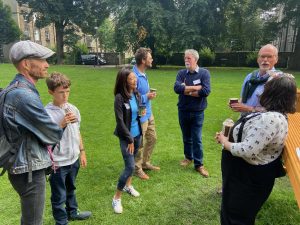
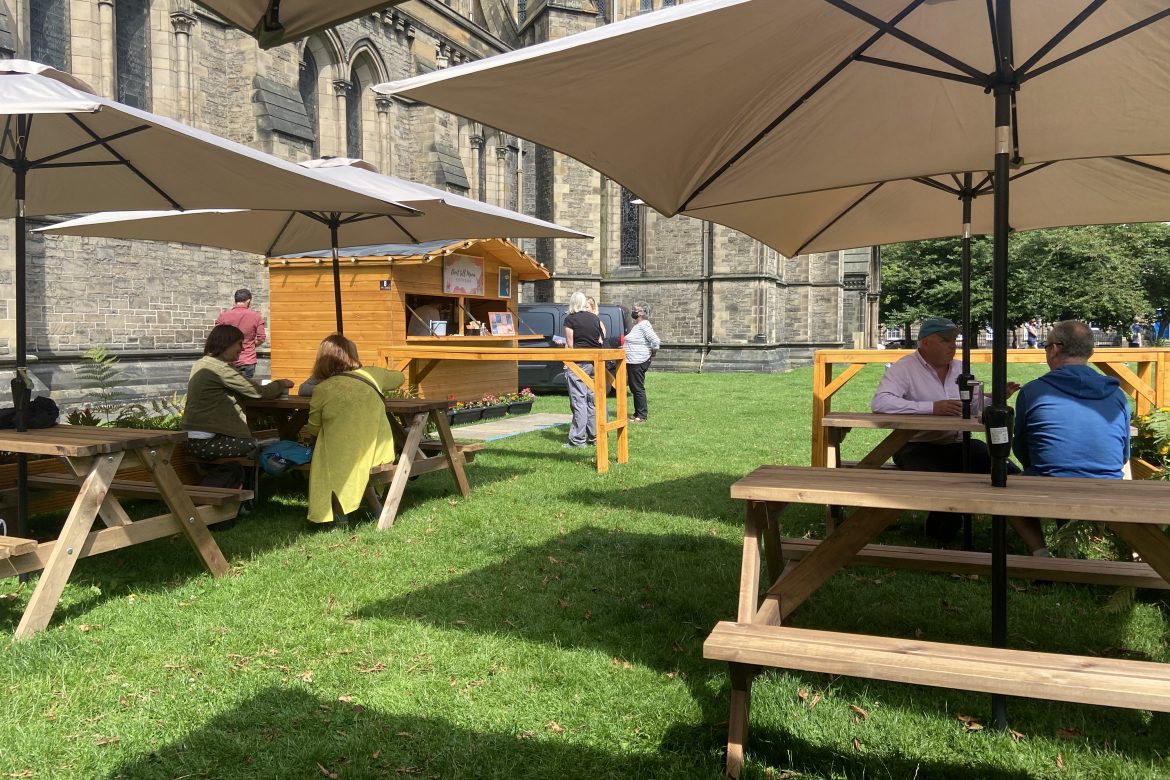
Then, in mid-July 2021, arrived the Don’t Tell Mama coffee stall outside St Mary’s Cathedral, on a grassy area normally used mostly for dog-walking. It was the cathedral’s initiative, and the Greek owners of their coffee shop in Tollcross stepped forward. They clearly invested in the site, with a booth, wooden seating, flowers, umbrellas/sun shades and so on.  It’s a wonderful addition to our neighbourhood, where people can come, meet, chat, bump into one another, see each other, all in an outdoor safe setting.  And Stathis and his team serve up excellent coffee, spanakopita (savoury pastries) and brownies to Westenders, dog walkers, people have earnest chats and those just enjoying the Edinburgh summer.

Our team of Facebookers had a chat and decided to announce a Westenders Sunday Get-together, just to invite folks along to meet each other, buy a coffee if they wished and start to make face-to-face contact.  After a couple of gloomy Sundays when the weather didn’t play ball, we finally went for it on Sunday 22 August. About a dozen Westenders turned out, we all made badges with our names and streets, and chatted for about an hour and a half. A modest gathering for sure, but a start!  Those who came (who had lived in the West End for anything from 4 weeks to 15 years!) all enjoyed it, said how useful it was to have community connection online and also to have a chance to ‘meet the neighbours’.

The cafe is only open during the summer (understandably), and we are planning another get-together in September to take advantage of the facility.  It’s a real boon to the neighbourhood, offering a different way to meet and a different kind of space for us to enjoy our wonderful surroundings.  I hear that the cathedral are having problems with getting planning permission to do it again next year. I hope very much that we can rally around and help convince the council that it’s not just another cafe but a really vital addition to the area over the summer months.


Building Stronger Communities Through Critical and Compassionate Schooling – 24 August 2021

Earlier in the year we were delighted to host Dilia Swart and her colleagues from Protection Approaches as they spoke about community building as a route to tackling identity based violence.  Dilia has been in touch to say that they have a new report being launched at an event on 24 August 2021 about the role of critical and compassionate schooling.  She writes:

“I am reaching out to share with you that on 24 August we will be releasing our newest publication called Building Stronger Communities Through Critical and Compassionate Schooling.

I thought that you or members of your network might like to join the online launch event of the paper on the 24th of August at 4pm BST. The event will be chaired by Gráinne Hallahan, Senior Analyst at Times Education Supplement. The conversation will open with my short presentation of the paper’s main findings. Kavita Tanna, Director and Founder of Globally Reconnect, and John Murphy, CEO of Oasis Community Learning will then respond to the report and discuss how schools in the UK and elsewhere can prioritise critical and compassionate schooling. A Q&A will follow.

You can register for the event using this link: https://us02web.zoom.us/webinar/register/WN_ug-m12SiQ1mMAFvLmzlWnQ

Drawing on over two years of research in and with schools this new research paper sets out how schools and schools-based education can confront some of the greatest crises we face, from social polarisation and rises in identity-based violence to the growing challenges of fake news and conspiracy.

There is widespread demand for education systems to be able to prioritise the Skills young people need to respond to our new and often complex reality, from democratic backsliding to climate change. This paper sets out a low-cost, high-impact vision for schools, civil society, and government to equip young people with the tools they need to navigate these crises, to develop the confidence to participate in society, and contribute to the long-term resilience of the UK to ongoing and future challenges.”

This is going to be an excellent event – please do join if you can!

Village In The City is a post-COVID initiative to help you build micro-local communications and communities where YOU live.

Sign up

Our Contacts

20 Atholl Crescent, Edinburgh EH3 8HQ

+44 (0)7976 936086

mark@villageinthecity.net